Green Economy-orientedManpower Training Business
Green Economy-Oriented Training is an economic activity that is environmentally conscious, involves local communities, and brings both profit and welfare.
LPTM is a vocational training enterprise, primarily focused on heavy equipment operation training, designed for anyone who wishes to acquire certified work skills and be ready to enter the workforce.
One of LPTM's four training centers, namely the LPTM training center in Gowa, is developed as a Green Economy-oriented training site.
At this location, the three frameworks of the green economy are applied.
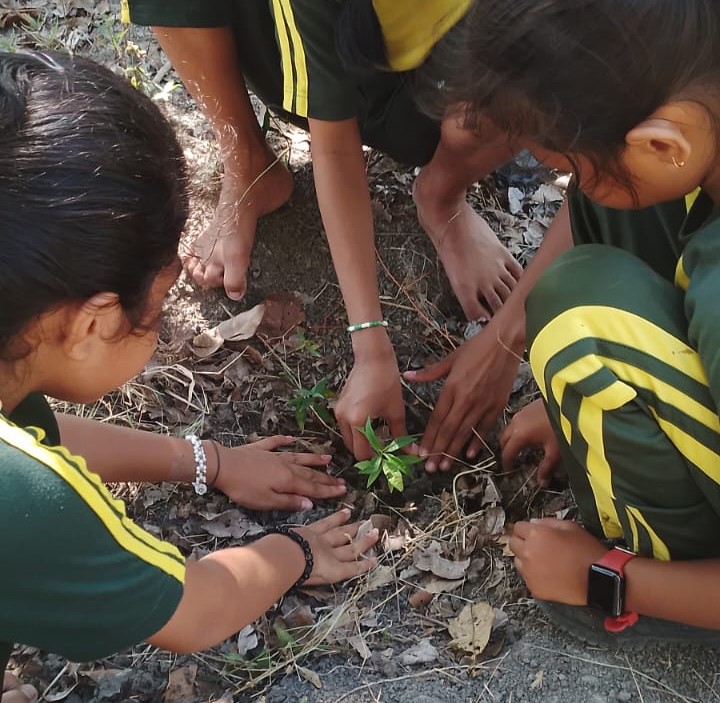
From an environmental perspective, the training site in Gowa is designed with the planting of 5.000 Bitti trees (Vitex cofassus), 1,000 bamboo trees, and 500 Aren Genjah tress which serve as dust, noise, and vibration barries, while alsi provifding raw materials for organis fertilizer.

The use of used plastic drinking cups as containers for seedling Bitti trees and others

Planting bamboo tress to absorbs dust and as a material for making organic fertilizer

Planting of 5.000 Bitti trees (Vitex Cofassus)
In addition, plastic reduction practices are applied through the reuse of participants used drinking cups as seedling containers, and reduction of single-use plastic within the training site. Organic waste is sorted and composted, while rainwater is harvested through infiltration wells and bioppres.
Beyond infrastructure, the principles of the green economy are also enbedded into the training curriculum. This ensures participants gain not only technical skills but also long-term environmental awareness. Additionally, training on solar panel installaton and the use of solar energy during the dyatime has been initiated to support environmentally friendly energy independence.
From a community empowerment perpective, LPTM opens partnership opportunities with local residents as providers of boarding rooms, food stalls, and other supporting needs. LPTM also initiated the establisment of the Kelompok Tani HUtan (KTH) "Pakoko Assamaturu" in Pabbentengang Village, Bajeng Subdistrict, Gowa Regency, with 39 members.

The first meeting to establish KTH Pakoko Assamaturu

Construction of accommodation for training participants

Provision of food stalls for training participants
The KTH, chaired by Bapak Haeruddin, was officially registered under Registration Number 73/06/02/2007/KTH.288/2025 on June 10, 2025, and has received support from KPH Je'neberang in the form of seedlings of Red Japon, Grafted Avocado, Musang King Durian, and Nutmeg. The existence of this KTH provides a platform for the community to manage community forests, support reforestation, and sustainably utilize forest products.

Excavator heavy equipment operator training

Welding technique training

Solar panel installation training
The benefits of the Green Economy-oriented manpower training program are not only experienced by participants but also by the surrounding community. Training participants gain technical skills that enable them to enter the workforce and earn income. LPTM itself creates new jobs, both for trainers and staff. Meanwhile, the surrounding community benefits economically through business opportunities such as providing accommodation and meals. Business owners also gain to chance to expand within a more competitive and sustainable business ecosystem
In addition to training activities, LPTM also provides green economy advisory services for provincial and district govenrnments wishing to develop green economy-based areas, whether in local regions, industrial zones, or residential areas. In the future, LPTM plans to expand its training programs with a focus on Green Economy Awareness and Sustainable Development, targeting civil servants, private sectors actors, job seekers, and the general public.
Considering that the future of developement will demand the availibility of human resources who understand green economy principles, this training is believed to be an essential provision for entering an era of development that is more environmentally friendly, sustainable, and prosperous.